
3D-Printed vs Molded Hydroponic Towers: Which Is Better?
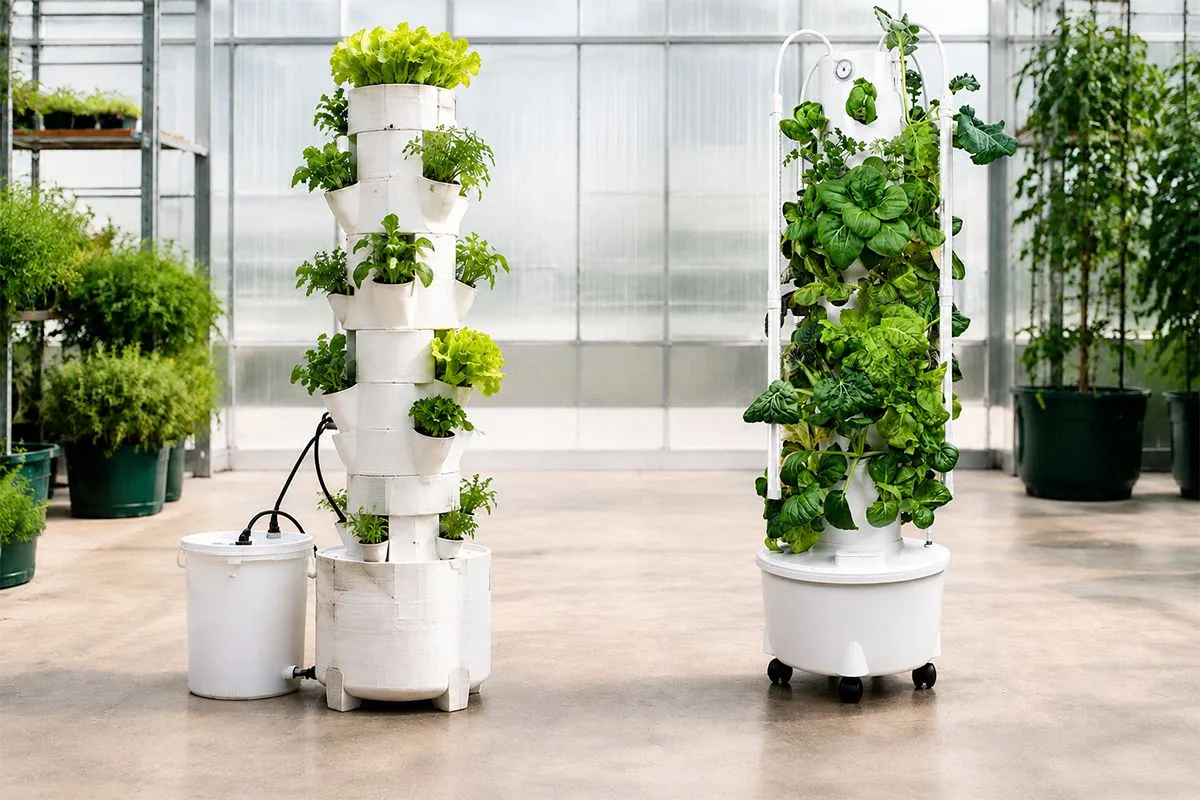
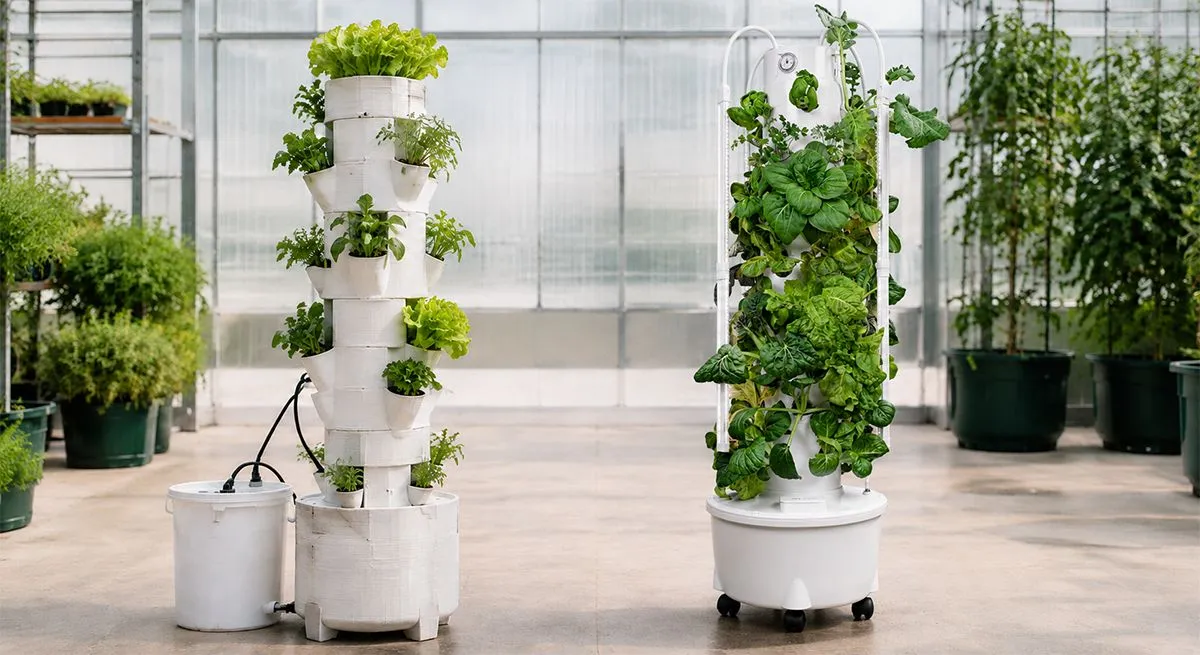
3D-printed and molded hydroponic towers can both grow healthy plants, but they are built for entirely different users and use cases. While printed towers offer ultimate customization and DIY repair, molded towers typically provide much smoother surfaces, highly consistent part fit, effortless cleaning, and far more predictable long-term performance.
For most home growers, educational schools, farm-to-table restaurants, commercial greenhouses, and multi-tower agricultural projects, a professionally engineered molded tower is undoubtedly the more practical choice. A 3D-printed tower makes more sense when the builder already owns a 3D printer and views the construction and troubleshooting process as a rewarding part of the hobby.
The comprehensive comparison below focuses on the critical differences that actually matter in daily hydroponic use: cleaning efficiency, leak prevention, material safety documentation, outdoor UV durability, true total cost, and reliable replacement parts.
The Short Answer
Choose a 3D-printed hydroponic tower if:
- You already own a highly capable and calibrated 3D printer.
- You enjoy hands-on DIY projects, tuning, and troubleshooting.
- You specifically want to modify or hack the design parameters.
- You are comfortable repeatedly testing the system for microscopic leaks.
- You possess the skills to reprint damaged, degraded, or poorly fitting components.
- The act of building the system is just as interesting to you as actually growing the plants.
Choose a molded hydroponic tower if:
- You want a hassle-free, ready-to-assemble growing system out of the box.
- Effortless and fast system cleaning is a high priority for you.
- You absolutely need consistent, watertight fit between all tower sections.
- The tower will be subjected to regular daily use or commercial-grade operation.
- You want access to established manufacturer warranties, support, and reliable replacement parts.
- You plan to grow plants outdoors in the sun or inside a high-temperature greenhouse.
- You are purchasing several identical towers and need them to function identically.
It is important to note that neither production method automatically guarantees a flawless tower. Factors like material quality, structural wall thickness, integrated UV protection, water distribution efficiency, pump accessibility, and overall ergonomic design still critically matter.
What Is a 3D-Printed Hydroponic Tower?
Most DIY vertical growing towers are produced using fused deposition modeling, commonly referred to as FDM printing. In this process, the 3D printer melts thermoplastic filament and deposits it meticulously, one layer at a time, until each individual tower section is fully constructed.
PETG is one of the most frequently discussed and utilized materials for this kind of agricultural project due to its balance of strength and water resistance. PLA and ASA are also used, although they behave drastically differently under high heat, direct sunlight, constant moisture, and specific printing conditions.
A typical 3D-printed tower may include:
- Stackable printing sections that form the main body.
- Printed net cups or specialized cup holders.
- A printed top cap functioning as a water distributor.
- A separate bucket or container acting as the reservoir.
- A submersible water pump.
- Flexible tubing, a timing outlet, and optional printed grow-light support brackets.
While the design files may be free or purchased cheaply from a 3D model marketplace, downloading the files is only the very beginning of the journey. The builder still needs to expertly choose the right filament, dial in the printer settings, source a compatible pump, find a safe reservoir, buy tubing and fittings, install lighting, and program the watering schedule.
What Is a Molded Hydroponic Tower?
A molded hydroponic tower is manufactured by forming molten plastic inside a heavy-duty, purpose-built steel mold. Injection molding is the standard commercial process for creating tower sections, internal fittings, covers, water reservoirs, and planting components.
Once the expensive mold is created and the production settings are locked in, the manufacturer can produce massive numbers of practically identical parts. This industrial process usually results in highly predictable dimensions and a significantly smoother surface finish than even the best standard FDM print.
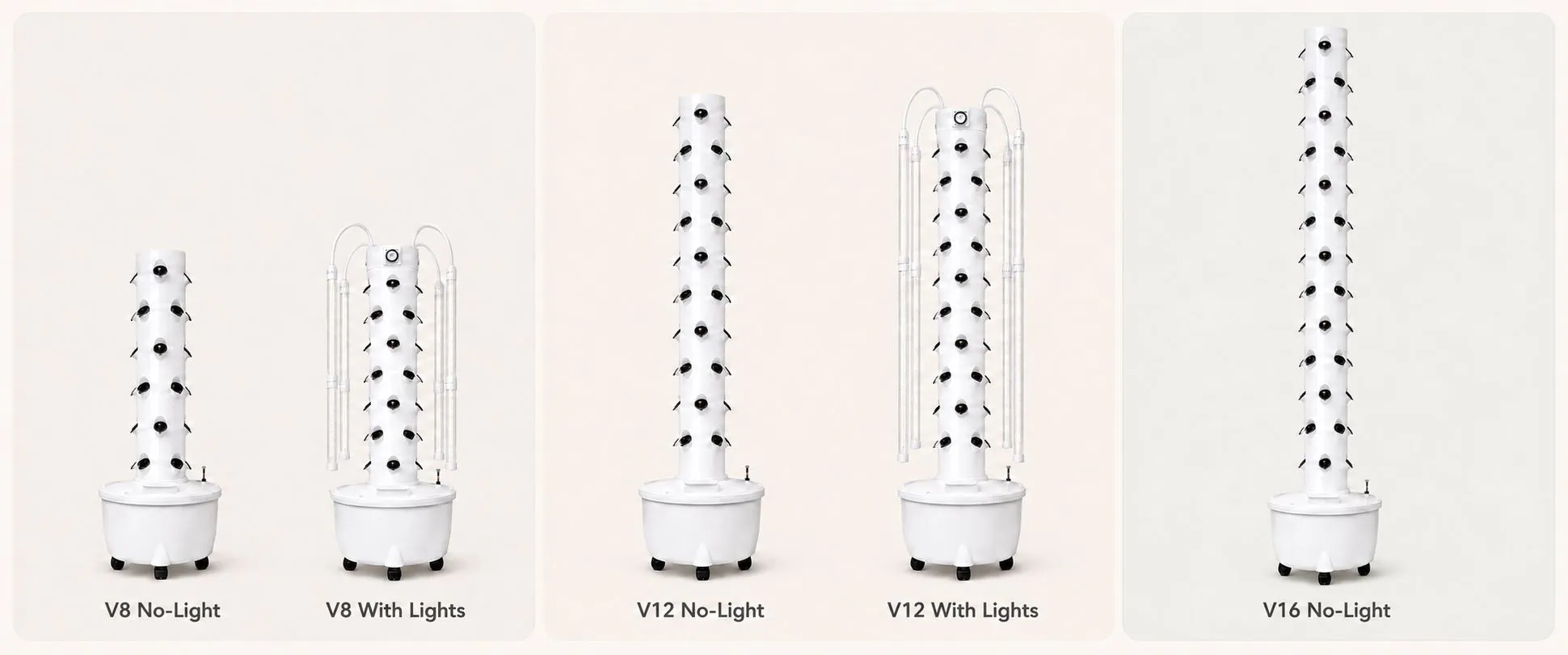
Molded towers are generally supplied to consumers as complete, turnkey systems. Depending on the exact model, the retail package typically includes the main tower body, a perfectly fitted water tank, a perfectly spec’d pump, an automated timer, reusable net cups, full-spectrum LED lights, rolling wheels, and sometimes even seed-starting accessories.
The buyer still needs to manage the fun parts—water, liquid nutrients, pH balancing, plant care, and routine cleaning—but completely bypasses the need to manufacture the actual hardware itself.
Examples of Molded Yunzy Hydroponic Towers
For growers who heavily prefer a reliable, ready-to-assemble molded system, Yunzy offers several advanced planting configurations tailored for different spaces and ambitious growing goals:
- Yunzy V8 Hydroponic Grow Tower — Features 40 distinct planting sites, perfect for standard homes, tight patios, apartment balconies, and small hobby greenhouses.
- Yunzy V12 Hydroponic Grow Tower — Offers 60 planting sites, designed for regular high-yield home harvests, farm-to-table restaurants, and serious indoor growing projects.
- Yunzy V16 Hydroponic Grow Tower — Boasts a massive 80 planting sites, engineered for outdoor spaces, commercial greenhouses, hospitality venues, and small-scale commercial vertical farming projects.
3D-Printed vs Molded Hydroponic Towers: Quick Comparison
| FEATURE | 3D-PRINTED TOWER | MOLDED TOWER |
| Best suited to | Makers, hobbyists, and experimental DIY projects | Home growers, schools, restaurants, and commercial projects |
| Customization | Very high; fully modifiable | Limited to manufacturer configurations |
| Surface finish | Visible layer lines and microscopic grooves are common | Generally much smoother and highly uniform |
| Water resistance | Depends heavily on individual print settings and design | Usually highly consistent when professionally manufactured |
| Cleaning | Layer lines and narrow passages may require extensive scrubbing | Smooth, easily removable sections are generally much easier to clean |
| Material selection | Controlled entirely by the person printing | Controlled and certified by the manufacturer |
| Assembly | May require drilling, manual sealing, custom fitting, and leak testing | Usually designed for quick, repeatable, tool-free assembly |
| Replacement parts | Can be reprinted if digital files and a working printer are available | Can be reliably purchased directly from the supplier |
| Production consistency | Varies wildly with printer calibration and operator skill | Perfectly suited to exact repeat production |
| Initial cost | Can be reasonable only if printing equipment is already owned | Higher upfront purchase price but eliminates DIY assembly steps |
| Outdoor use | Depends heavily on specific filament choice and print quality | Depends on specialized resin, UV additives, and product engineering |
| Appearance | Functional, highly customizable, and visibly 3D-printed | More polished, premium, and appliance-like |
1. Surface Finish and Cleaning
The most immediately visible difference between the two methods is the surface texture.
An FDM-printed part is constructed from hundreds or thousands of individual stacked layers. Even an exceptionally good print normally has small, microscopic grooves between those layers. Over time, nutrient residue, stubborn algae, and extremely fine plant roots can easily settle into these rough areas, especially inside the core of the tower where physical access is heavily limited.
Prusa’s official guidance on food-related FDM printing explicitly notes that the tiny grooves between printed layers can trap and hold biological residue, making them notoriously difficult to clean thoroughly. This does not mean every single printed tower is inherently unusable, but it does mean that surface quality and sanitation deserve serious, ongoing attention.
Molded parts, on the other hand, are normally exceptionally smooth. While they may still possess manufacturing seams, corners, or internal channels, they absolutely do not feature the same repeated, porous layer texture found on a standard FDM print.
For a hydroponic system that will be emptied, scrubbed, and cleaned many times over its lifespan, smooth surfaces and wide access points make a massive, noticeable difference in maintenance time.
Crucial cleaning questions to ask include:
- Can every single tower level be easily separated for deep cleaning?
- Can a standard cleaning brush easily reach the deep inside of the planting ports?
- Can thick, old roots be removed aggressively without permanently damaging the plastic surface?
- Are there narrow, inaccessible channels where hard mineral deposits can permanently collect?
- Can the main reservoir opening comfortably fit an adult hand or a large cleaning brush?
- Will the manufacturer-recommended cleaner accidentally degrade the plastic or strip its coating?
2. Leaks and Watertightness
A 3D print that appears perfectly solid to the naked eye is not necessarily watertight.
Microscopic gaps can frequently form between printed lines or stacked layers. Print temperature fluctuations, extrusion rate inconsistencies, inadequate wall thickness, layer height settings, nozzle size, ambient filament moisture, and even part orientation can all drastically affect the final watertight result.
This exact unpredictability is why many experienced DIY builders opt to use a completely separate, commercially molded bucket as the main reservoir instead of attempting to print the entire water tank. The solid molded bucket safely holds the main volume of water and can also catch small amounts of unexpected vertical drainage or seepage.
Before planting, a printed tower must be rigorously tested with plain water. Check:
- The very bottom of every printed modular section.
- All screw, bolt, and mounting holes.
- Internal and external tubing connections.
- The structural joints between stacked tower levels.
- The main reservoir lid and access ports.
- The primary pump outlet.
- Any geometric areas where the print rapidly changes direction.
Molded tower sections are normally far more repeatable, but it is vital to remember that “molded” does not automatically mean “leak-proof.” Poor silicone seals, loose tubing, damaged PVC fittings, dangerously thin walls, and incorrect user assembly can still easily cause leaks.
The primary difference here is consistency. A professionally molded part should behave exactly like the million previous parts made from that same mold.
3. Strength and Long-Term Durability
Due to the nature of FDM manufacturing, a 3D-printed part is physically not equally strong in every direction. The thermal bonds between horizontal layers can easily become structural weak points, particularly if the exact print settings were not perfectly matched to the specific filament chemistry.
This structural integrity matters immensely because a hydroponic tower carries significantly more than just its own plastic weight. It must reliably support the heavy weight of soaking wet roots, massive mature plants, internal water tubing, heavy LED grow lights, and the dynamic physical force created when users forcefully remove plants or repeatedly separate the sections for cleaning.
Small stress cracks may begin to form around:
- Heavy planting pockets carrying mature crops.
- Overtightened screw holes.
- Extremely thin wall transitions.
- Friction-fit tower connections.
- Cantilevered light-support brackets.
- Any areas repeatedly exposed to movement or vibration.
Molded parts can also certainly crack if the chosen resin, wall thickness, internal rib structure, or underlying mold design is poor.
A massive molded panel featuring sharp, unreinforced corners may actually fail sooner than a thoughtfully engineered, densely printed component. Ultimately, the production method heavily matters, but the core engineering matters even more.
4. Food-Contact Questions
“Is PETG safe for hydroponics?” is easily one of the most common, hotly debated questions surrounding 3D-printed towers.
The fundamental problem is that the generic name of the base material does not legally or chemically describe the whole finished part. A spool of filament may also contain undocumented pigments, chemical processing aids, and other proprietary additives.
Furthermore, the brass printer nozzle, the microscopic remnants of previous filament used in the machine, applied surface coatings, and harsh cleaning methods can all dangerously affect the final finished object’s food safety.
The FDA rightfully treats artificial colorants, glues, adhesives, chemical antioxidants, and other minor components as a critical part of the broader food-contact evaluation. In highly practical terms, a familiar resin name (like PETG) alone is absolutely not enough to confirm the true biological suitability of a finished hydroponic component.
When evaluating the safety of a printed tower, you must ask:
- Does the specific filament manufacturer provide transparent, official documentation for this exact product?
- Are all the included pigments and chemical additives clearly identified?
- Has the extruder previously pushed unknown, toxic, or unsuitable materials (like ABS)?
- What exact type of metal nozzle was used (brass can contain trace lead)?
- Is a food-safe epoxy coating strictly required?
- Can that specific coating withstand continuous water submersion and repeated abrasive cleaning?
- What happens to the water supply if the coating accidentally scratches or begins to peel?
This exact same caution absolutely applies to molded towers as well. Simply being ‘molded’ does not automatically mean a product is food safe. Discerning buyers should always ask exactly what material contacts the nutrient solution and firmly request whether the supplier has official documentation for the exact resin used and its intended agricultural use.
A professionally molded Yunzy polypropylene tower manufactured from a fully traceable, certified resin is an entirely different, vastly superior product compared to an unidentified, cheap molded plastic container.
5. PETG vs PLA for a Hydroponic Tower
PLA is incredibly popular worldwide because it is very easy to print and widely available in endless colors. However, it is generally considered far less suitable for a hard-working tower consistently exposed to high water temperatures, long-term continuous moisture, or strong, direct outdoor sunlight. PLA can warp under moderate heat.
While a PLA part may suffice for a quick indoor winter experiment, it should absolutely not be treated as the automatic, default choice simply because the filament is incredibly easy to use.
PETG is commonly chosen for ambitious DIY hydroponic towers because it generally handles constant moisture and physical impact far better than standard PLA. However, it can also be significantly more difficult to print cleanly. Issues like severe stringing, inconsistent extrusion, and poorly thermally bonded walls can drastically affect both the tower’s aesthetic appearance and its critical water resistance.
ASA is often highly considered for robust outdoor components strictly because of its exceptional weather and UV resistance. However, it normally requires much more strictly controlled enclosed printing conditions, ventilation, and careful handling during production.
There is no universally flawless filament. The right choice depends heavily on:
- Indoor vs. outdoor use.
- Ambient and water temperature.
- Direct sun and UV exposure.
- Specific printer capability and enclosures.
- Intricate part design and overhangs.
- Required operational lifespan.
- Official filament safety documentation.
- The builder’s willingness to manually seal or epoxy coat the surface.
6. UV Exposure and Outdoor Use
Outdoor hydroponic towers experience brutal direct sunlight, high ambient heat, torrential rain, heavy wind, and much wider daily temperature fluctuations than climate-controlled indoor systems.
Prolonged UV exposure can quickly fade vibrant colors and severely weaken some uncertified plastics over time, causing them to shatter. High heat can dangerously soften certain printed materials (like PLA) and rapidly warm the circulating nutrient solution. Furthermore, repeated daily heating and cooling cycles may also place immense thermal stress on printed layer bonds, leading to delamination.
A darkly colored printed tower can become especially, dangerously warm in direct afternoon sunlight. That does not only structurally affect the tower body—it may also rapidly raise the temperature of the nutrient solution, stripping it of oxygen and causing severe root rot.
For an outdoor 3D-printed tower, always meticulously check:
- The filament’s officially stated outdoor UV suitability.
- The chosen color and its expected heat absorption rate.
- Whether the part will remain dimensionally stable under a hot sun.
- The application of aftermarket UV-resistant coatings.
- How damaged or peeling coatings will be safely repaired.
For a molded outdoor tower, rigorously check:
- The core base resin (e.g., high-quality PP).
- The inclusion of specialized UV-stabilizing additives.
- Overall structural wall thickness.
- Explicit outdoor-use manufacturer instructions.
- Specific warranty exclusions regarding sun damage.
7. Customization and Design Freedom
This specific area is exactly where 3D printing commands a massive, undeniable advantage.
A skilled builder can digitally change the tower height, perfectly adjust the planting-pocket angle, modify the net-cup diameter, redesign the water-distribution cap, integrate a custom pH sensor holder, add a slick tubing guide, or design a bespoke LED light bracket. If a specific section is damaged, it can be digitally reinforced and modified before it is ever printed again.
However, it can also quickly become an exhausting trap. Every single modification introduces yet another unpredictable variable. A suddenly taller tower may desperately need a much stronger water pump. A visually larger planting pocket may accidentally weaken the structural section around it.
Adding more dense planting sites may severely reduce airflow spacing and make routine cleaning incredibly harder. A fancy new water distributor may look visually stunning but deliver terribly uneven water flow to the roots.
Molded towers inherently offer far fewer opportunities for structural modification, but their core design is normally thoroughly optimized, fixed, and highly repeatable. For the vast majority of buyers, that perceived limitation is actually incredibly useful. They simply want to reliably grow fresh lettuce, not reverse-engineer and redesign the plumbing every single weekend.
8. Cost: Is 3D Printing Really Cheaper?
A DIY tower project can easily look incredibly inexpensive when the flawed calculation only includes the raw cost of the plastic filament.
A much more realistic, complete budget must include:
- The high initial cost of the 3D printer itself.
- Ongoing printer maintenance and replacement brass/steel nozzles.
- Dozens of rolls of high-quality filament.
- The inevitable cost of failed prints, warping, and wasted prototypes.
- The electrical cost for exceptionally long, multi-day printing jobs.
- Premium downloaded 3D design files (if not free).
- A safe, food-grade main water reservoir.
- A reliable submersible water pump.
- An automated electrical timer.
- Safe tubing and watertight fittings.
- Food-safe epoxy sealants or UV coatings.
- Appropriately sized net cups and grow media.
- Full-spectrum LED lights and sturdy light supports.
- Water testing equipment (pH and EC meters).
- The immense, uncalculated value of the builder’s own time.
If you already proudly own a highly reliable printer and genuinely enjoy the meticulous process, the total cost may indeed be reasonable.
However, if you are purchasing a brand-new 3D printer solely to manufacture one single hydroponic tower, a premium, ready-made molded commercial system will almost certainly cost significantly less than expected.
9. Replacement Parts and Repairs
A 3D-printed tower proudly offers an unusual, empowering kind of independence. If you securely possess the digital files, the functioning printer, and the exact correct filament, you can theoretically produce another perfect section whenever something unexpectedly breaks.
However, that distinct advantage relies entirely on continued, uninterrupted access to all three of those variables.
You must critically ask:
- Do you legally own the raw design file, or do you only have restricted permission to use a compiled version?
- Is the original creator’s file still securely available online?
- Can your current, aging printer successfully reproduce the exact same tight dimensions as it did years ago?
- Is the exact same brand and color of filament still being manufactured and sold?
- Will a brand-new, freshly printed rigid part actually fit onto an older, slightly sun-warped or faded section?
Conversely, molded replacement parts must normally be sourced directly from the original manufacturer. Before committing to a purchase, rigorously check whether critical components like water pumps, individual tower levels, planting baskets, rubber seals, tubing, LED lights, and custom connectors can be easily ordered separately.
A cheap molded tower sold with absolutely zero available spare parts is definitely not automatically more repairable than a DIY printed one. Comprehensive supplier support and parts availability are an integral part of the actual product.
10. Consistency and Multiple-Tower Projects
A single, isolated DIY tower sitting in a corner can easily tolerate some manual adjustment and quirky behavior. However, scaling a project up to 10, 50, or 100 towers is a completely different logistical challenge.
At a larger commercial scale, small, seemingly insignificant inconsistencies rapidly compound into massive operational headaches. If printed tower sections fit together slightly differently, water pumps deliver uneven flow rates across the room, or standard cleaning tools do not seamlessly fit every single unit, routine daily maintenance becomes agonizingly slower and spare-part management becomes a chaotic, complicated nightmare.
Molded towers are inherently vastly better suited to repeat, scaled production simply because the parts are industrially designed to utilize the exact same precision dimensions across an entire manufacturing run.
This consistency matters immensely for:
- Commercial Greenhouses
- Farm-to-Table Restaurants
- Educational Schools and Universities
- Community Gardens and Urban Farms
- Hospitality Projects (Hotels and Resorts)
- Retail Demonstrations and Supermarkets
- Small-scale Tower Farms
For these specific, high-volume buyers, professional appearance, perfectly repeatable assembly, minimized cleaning time, official safety documentation, and guaranteed replacement-part supply often matter significantly more than the ability to uniquely customize each tower.
Which Tower Is Better for Home Growing?
For a technical hobbyist who already thoroughly enjoys 3D printing, creating a DIY tower from scratch can be an incredibly satisfying, rewarding project. It provides the builder with ultimate control and serves as a fantastic, hands-on way to deeply learn about fluid dynamics, water pump sizing, water distribution, precise plant spacing, and overall agricultural system design.
However, for a typical busy household that primarily just wants to easily harvest fresh, crisp lettuce and aromatic herbs for dinner, a premium molded hydroponic tower is universally easier. The initial assembly is vastly faster, the premium finish is much smoother, and the eager buyer does not have to frustratingly troubleshoot the entire plastic manufacturing process before they can finally start sowing seeds.
The ultimate deciding question is: Do you want a 3D-printing engineering project that happens to grow plants, or do you want a highly efficient growing system that happens to be made from plastic? Both distinct paths can be highly worthwhile, but they deliver a completely different user experience.
Which Tower Is Better for Outdoor or Greenhouse Use?
A meticulously designed ASA or highly suitable PETG printed tower may survive outdoors, but the builder desperately needs to intimately understand UV exposure degradation, thermal heat absorption, layer shear strength, material safety documentation, and long-term water resistance.
For regular, reliable greenhouse or outdoor crop production, a professionally molded tower manufactured from an appropriate, heavily UV-stabilized material is generally the far more predictable, durable choice.
Buyers should still rigorously confirm that the molded product is genuinely, officially intended for outdoor use. Merely having a white color alone absolutely does not definitively prove integrated UV resistance.
Which Tower Is Better for Commercial Growing?
For repeated, high-stakes commercial use, professionally molded towers universally hold the overwhelming advantage.
Commercial growers absolutely require:
- Perfectly consistent, identical dimensions across all units.
- Lightning-fast, repeatable assembly.
- Incredibly easy, standardized cleaning protocols.
- Highly predictable, even water flow.
- Instantly replaceable standard components.
- Fully documented, certified food-grade materials.
- A reliable, long-term corporate supply chain.
- A consistent, highly professional visual appearance across the entire project
A smart, hybrid farm could effectively utilize 3D printing for creating custom sensor holders, clever tubing clips, specialized covers, bespoke brackets, and rapid prototypes, while firmly relying on proven molded parts for the critical main tower body and plumbing network.
Frequently Asked Questions
Are 3D-printed hydroponic towers actually food safe?
They can potentially be suitable for safely growing edible plants, but true food-contact suitability cannot be determined from the generic words ‘PETG’ or ‘PLA’ alone. The exact proprietary filament, chemical additives, color pigments, printer hardware setup, brass nozzle, resulting surface finish, applied epoxy coating, and chosen cleaning method must all be carefully evaluated.
Do 3D-printed hydroponic towers commonly leak?
Yes, many do. Ultimate watertightness depends heavily on the specific 3D model design, filament quality, wall thickness, extruder settings, thermal layer bonding, plumbing fittings, and careful assembly. Every single printed tower should be extensively tested with plain water for days before valuable plants are ever added.
Is PETG definitively better than PLA for hydroponic towers?
PETG is commonly preferred by experts because it generally handles constant moisture, physical impact, and moderate ambient heat far better than standard PLA. However, the exact filament formulation and the ultimate print quality still matter immensely.
Should a 3D-printed hydroponic tower be epoxy coated?
A suitable, food-safe epoxy coating may dramatically improve water resistance and make the rough surface much easier to clean. However, it also introduces yet another material that must remain chemically stable under continuous moisture and abrasive cleaning. Scratched, peeling, or poorly cured chemical coatings can quickly create severe new toxic problems.
Exactly how long does a 3D-printed hydroponic tower last?
There is absolutely no standard, guaranteed lifespan. It depends entirely on the specific filament, printing quality, structural wall thickness, direct sunlight exposure, ambient temperature, heavy plant load, harsh cleaning chemicals, and exactly how often the tower is physically dismantled.
Is it financially worth buying a 3D printer just to build one tower?
Usually not, especially if the tower is the only reason for buying the printer. The high cost of the printer itself, inevitable failed parts, expensive filament, external pump, safe reservoir, LED lights, fittings, and your valuable time may easily bring the true total close to—or above—the price of a premium ready-made system. It makes much more sense if you already desire a 3D printer for various other projects.
Are molded hydroponic towers always automatically better?
No. A poorly engineered molded tower may still be incredibly difficult to clean, utilize cheap, unsuitable material, have dangerously weak walls, or lack available replacement parts. The manufacturing method is only one critical part of overall product quality.
Can custom 3D-printed parts be used with a premium molded tower?
Yes, absolutely. Printed sensor brackets, custom tubing guides, specialized covers, and unique light mounts can be incredibly useful additions. Just always keep the material safety and cleaning requirements in mind whenever a printed accessory physically touches the water or the roots.
Final Thoughts
The nuanced difference between 3D-printed and molded hydroponic towers is absolutely not simply a reductive argument of ‘DIY versus professional.’
A carefully designed and expertly printed tower can certainly grow healthy plants and give its proud owner a level of granular control that a fixed, commercial system simply cannot match. It is a fantastic fit for someone who genuinely enjoys building, rigorous testing, and constantly improving their equipment.
A molded hydroponic tower intentionally trades some of that endless freedom for ultimate consistency, reliability, and ease of use. It is generally vastly easier to quickly assemble, thoroughly clean, perfectly repeat, and officially support, which makes it infinitely better suited to the vast majority of households, schools, and commercial growing projects.
Before firmly choosing your path, always compare the entire finished systems—not just the way their plastic parts were manufactured. Look closely at the reservoir capacity, pump quality, water distribution method, material certifications, surface finish, sunlight exposure durability, cleaning access, availability of replacement parts, and the manufacturer’s long-term supplier support.
If you desperately want to experiment, endlessly customize, and print your own spare parts, a 3D-printed tower may be the perfect, engaging project for you.
If you simply want to seamlessly unpack the system, start your seedlings, and immediately focus on the joy of growing, a thoughtfully designed molded tower is undoubtedly the better, faster fit.
Buyers who prefer the ready-to-grow approach can easily compare Yunzy’s premium molded tower configurations by planting capacity and ideal growing environment:
- Yunzy V8 — 40 planting sites for compact spaces.
- Yunzy V12 — 60 planting sites for high home yields.
- Yunzy V16 — 80 planting sites for serious or commercial volume.

0 Comments