Hydroponic Tower vs NFT: Which System Is Better for a Small Farm?
Starting a small hydroponic farm often begins with one crucial decision: should you use hydroponic towers or an NFT system?
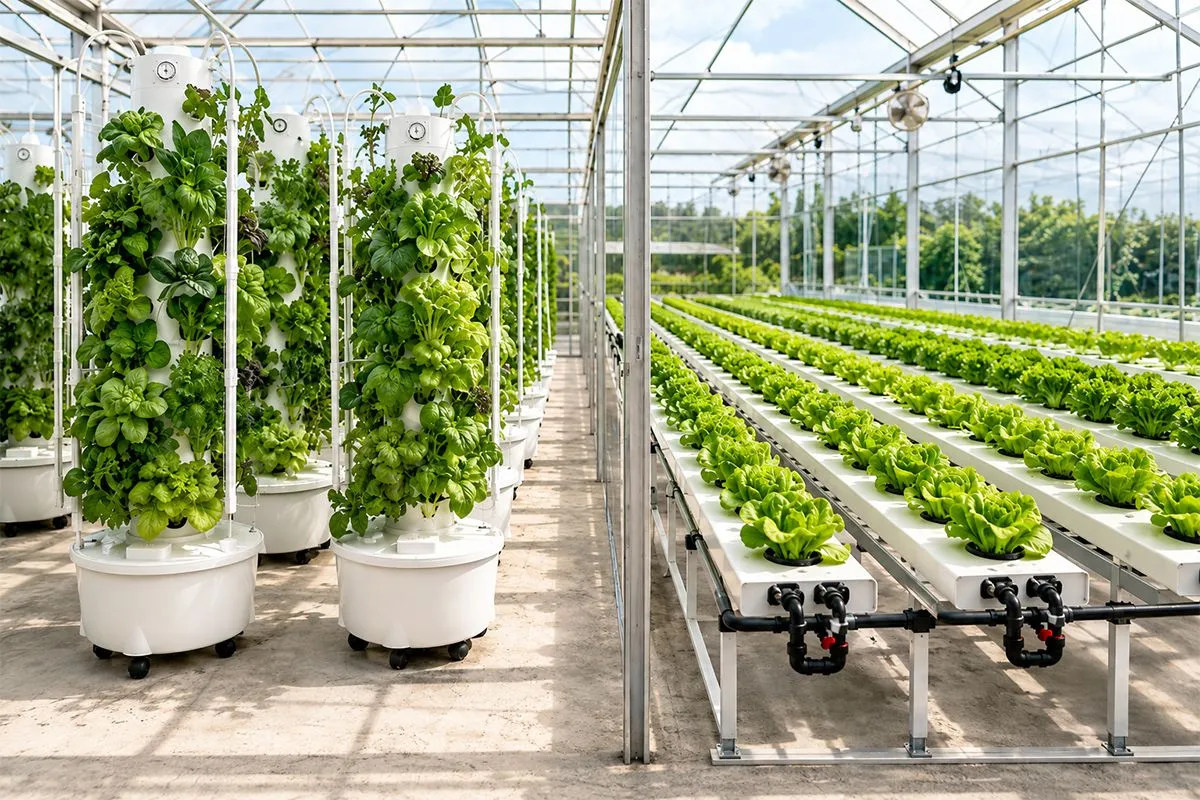
Both systems are widely used for growing leafy greens and herbs without soil, and both can work exceptionally well in greenhouses, urban farms, restaurants, educational projects, and small commercial growing spaces. However, they use physical space very differently.
NFT systems typically arrange plants horizontally along long growing channels, while hydroponic towers stack planting sites vertically around a central structure. That single difference affects almost everything else—from farm layout and plant access to expansion, cleaning, and crop planning.
There is no universal winner. The better choice ultimately depends on your available space, crop selection, budget, labor, production goals, and how you plan to scale your business in the future.
What Is an NFT Hydroponic System?
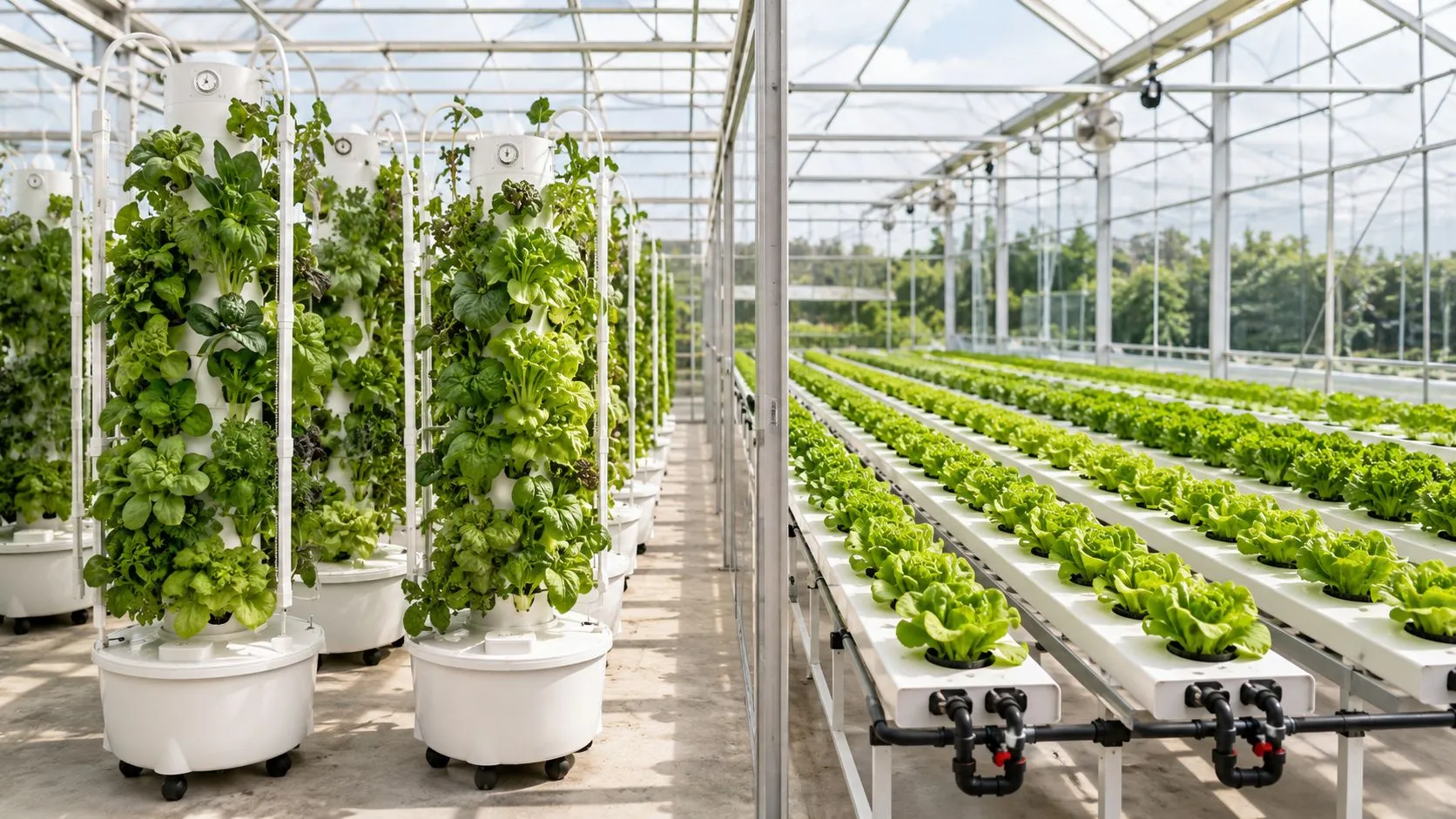
NFT stands for Nutrient Film Technique. In this setup, plants are placed in horizontal channels or gullies while a remarkably thin stream (or “film”) of nutrient solution continuously flows past their bare roots.
The basic operational process is straightforward and efficient:
- Nutrient solution is pumped from a central reservoir.
- Water flows continuously through slightly sloped growing channels.
- Plant roots absorb oxygen, water, and vital nutrients from the shallow stream.
- The remaining solution returns to the reservoir.
- The cycle repeats 24/7.
NFT is especially common for the commercial production of standardized crops like lettuce, basil, arugula, herbs, and other small leafy greens. Its organized horizontal layout makes it highly suitable for large greenhouses where growers have abundant floor area for long, uninterrupted production rows.
What Is a Hydroponic Tower System?
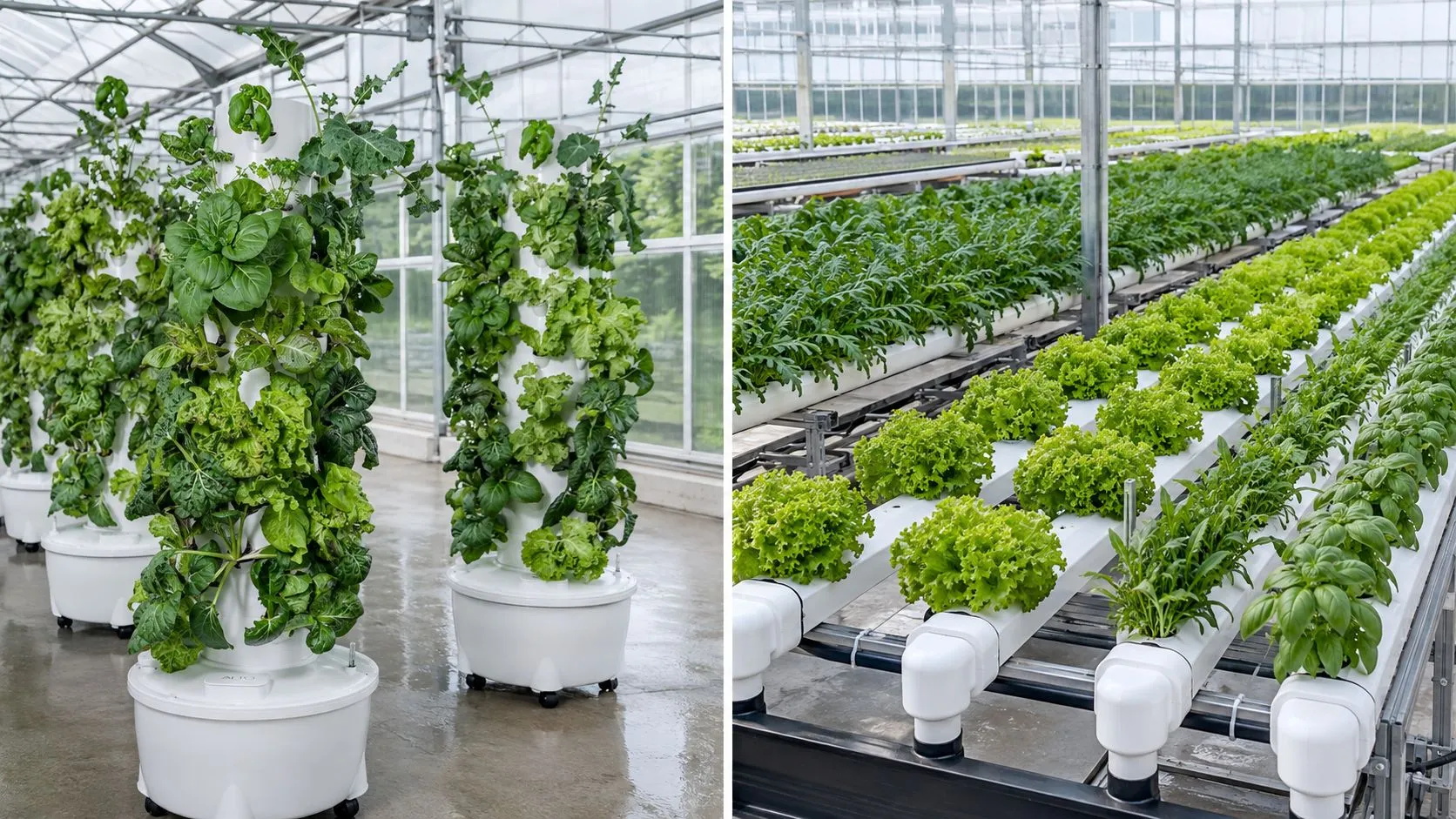
A hydroponic tower also utilizes a recirculating nutrient solution, but the growing sites are arranged vertically. Water is typically pumped toward the top of the tower and distributed evenly downward through the root zone via gravity before returning to the base reservoir.
Instead of spreading dozens of plants along a long horizontal row, a tower can place multiple growing levels within a fraction of the floor footprint. This unique design makes hydroponic towers particularly attractive for:
- Small to medium greenhouses.
- Urban and rooftop farms.
- Backyard growing spaces.
- Restaurant “farm-to-table” gardens.
- Community and educational projects.
- Any area where floor space is limited or expensive.
The major difference between the two systems is therefore not just how the plants receive nutrients, but how the farm maximizes its physical real estate.
Hydroponic Tower vs NFT at a Glance
To help you visualize the operational differences, here is a comprehensive breakdown of how both systems perform across key farming metrics.
| Farming Factor | Hydroponic Tower System | NFT System |
| Space Efficiency | Excellent use of vertical space (high density) | Requires longer horizontal floor rows |
| Farm Layout | Highly flexible and modular | Structured, linear, and rigid |
| Expansion Method | Simply add additional standalone towers | Extend channels, racks, plumbing, and reservoirs |
| Crop Suitability | Leafy greens, herbs, and compact fruiting vegetables | Especially strong for uniform leafy greens and herbs |
| Visual Appeal | High aesthetic value (great for customers) | Functional and commercial appearance |
| Harvest Workflow | 360-degree harvest around individual towers | Linear harvest along continuous channel rows |
| Best Suited For | Compact farms, restaurants, urban projects | Organized large-scale commercial production |
In-Depth Comparison: NFT vs. Hydroponic Towers
1. Space Efficiency and Farm Layout
NFT Channels are usually installed in long rows, horizontal racks, or multi-level benches. This layout works flawlessly when a greenhouse has expansive, uninterrupted floor space. However, to increase production, you must build outward, which can quickly consume expensive floor real estate.
Hydroponic Towers, conversely, use height rather than floor area. By positioning multiple planting sites vertically, growers dramatically increase plant capacity without a massive footprint expansion. The advantage comes from reclaiming unused vertical airspace, making towers incredibly valuable for compact, irregular, or high-rent urban spaces.
2. Scalability: Which System Is Easier to Grow?
Scaling an NFT farm requires a calculated structural overhaul: additional channels, heavier racks, larger industrial pumps, and complex drainage connections. Once built, it is highly efficient, but the initial scaling effort is substantial.
Tower Farms shine in their modularity. A grower can safely test the market with 5 to 10 towers, and easily plug in 20 more as demand surges. This drastically lowers the barrier to entry and minimizes financial risk for new agricultural entrepreneurs.
3. Crop Selection: Uniformity vs. Diversity
NFT setups are precision-engineered for uniform, lightweight crops (lettuce, arugula, pak choi). Growers often dedicate entire 50-foot channels to a single variety of butterhead lettuce for streamlined harvesting.
Tower Systems naturally support mixed planting flexibility. You can grow lettuce, kale, Swiss chard, and parsley on the exact same structure. This multi-crop capability is highly desirable for farmers’ markets, local restaurants, or subscription box (CSA) providers who need to offer a diverse vegetable portfolio.
4. Maintenance and System Security
In NFT channels, roots can sometimes grow aggressively and create blockages within the shallow PVC pipes, backing up water flow and affecting the entire crop line. Workers must constantly monitor channel flow.
Tower growers face different maintenance routines—inspecting internal pump circulation and tower modules. Because the modules are distinct, inspecting root health is often as simple as lifting a net pot out of its slot. Furthermore, if an NFT pump fails, roots dry out rapidly due to the lack of surrounding water. Tower structures often retain slight internal moisture, though backup power is strictly recommended for both systems.
Profitability and The Customer Experience
Which system is more profitable? The hard truth is that profitability depends entirely on your business model, not just the equipment. Your target market dictates your tech.
- If you are a wholesale supplier producing thousands of identical lettuce heads for grocery chains, NFT offers unmatched linear scale.
- If you are selling premium mixed greens to local restaurants, or if your farm is customer-facing, towers hold the edge. Towers are highly photogenic; they turn a farm into an attractive destination for restaurant patrons, students, and community members.
Final Verdict: How to Choose
Choose a Hydroponic Tower When:
- Floor space is limited, expensive, or irregularly shaped.
- You want to maximize vertical canopy space.
- You prefer low-risk, modular expansion (starting small).
- Your farm is visual, customer-facing, or educational.
- You need to grow a diverse mix of crops simultaneously.
Choose NFT When:
- You have access to a large, long, rectangular commercial greenhouse.
- Your business model relies on highly standardized, single-crop production.
- You want a predictable, linear commercial harvesting workflow.
Note: Hybrid farms are incredibly successful. You can easily utilize NFT for your bulk lettuce rows while maintaining a section of Hydroponic Towers for high-margin herbs and specialty greens!
Building a Small Tower Farm With Yunzy
For growers who decide that vertical hydroponic farming best aligns with their space and financial plans, Yunzy offers state-of-the-art hydroponic tower systems engineered for scalability. Instead of demanding a massive upfront capital investment, Yunzy allows you to start smart and expand as your demand grows.
Yunzy V12 – 60 Planting Sites
The Yunzy V12 Hydroponic Tower provides 60 planting sites distributed elegantly across 12 growing levels. It is the perfect unit for backyard projects, intimate restaurant gardens, and small tower farm startups looking to maximize leaf production without a heavy footprint.
Yunzy V16 – 80 Planting Sites (Commercial Scale)
Designed for serious outdoor and greenhouse commercial projects, the Yunzy V16 provides 80 planting sites across 16 levels. The outdoor-ready design capitalizes on natural sunlight, cutting down overhead electricity costs. A small cluster of V16 towers can generate massive yields without demanding long NFT channels:
- 5 V16 towers = Up to 400 planting sites in a fraction of a room.
- 10 V16 towers = Up to 800 planting sites, rivaling commercial row capacity.
The Yunzy Methodology: Start Small, Then Expand
One of the most profound advantages of a Yunzy modular tower farm is that you eliminate the pressure of building the entire project on day one. We recommend a proven 3-phase approach:
- Phase 1 – Test: Install several towers, measure real local demand, and track labor routines.
- Phase 2 – Optimize: Identify your best-selling, highest-margin crops and refine your nutrient routines.
- Phase 3 – Expand: Plug in additional towers seamlessly. As you scale, link multiple Yunzy towers to centralized irrigation and automated dosing systems.
Start with the capacity you need today, and let your farm grow organically alongside your business with Yunzy Farms.

0 Comments