
10-Tower Backyard Hydroponic Tower Garden with Irrigation and Dosing
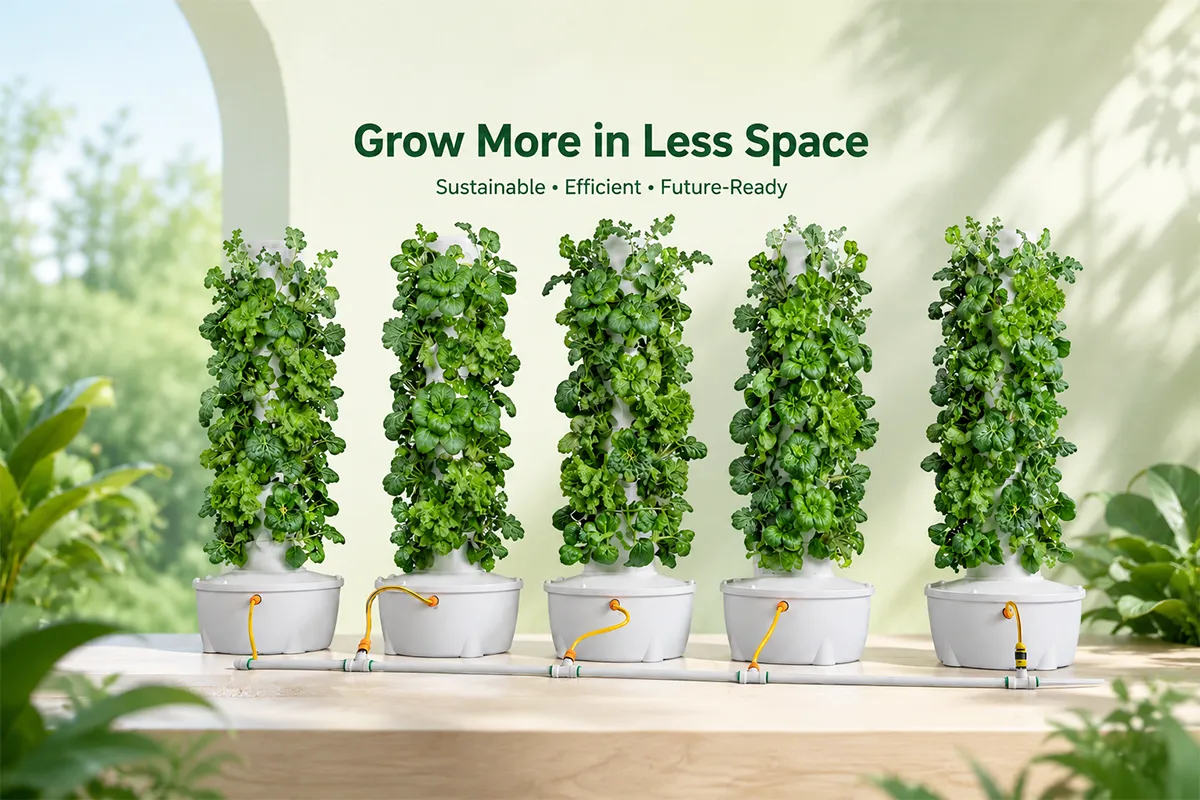
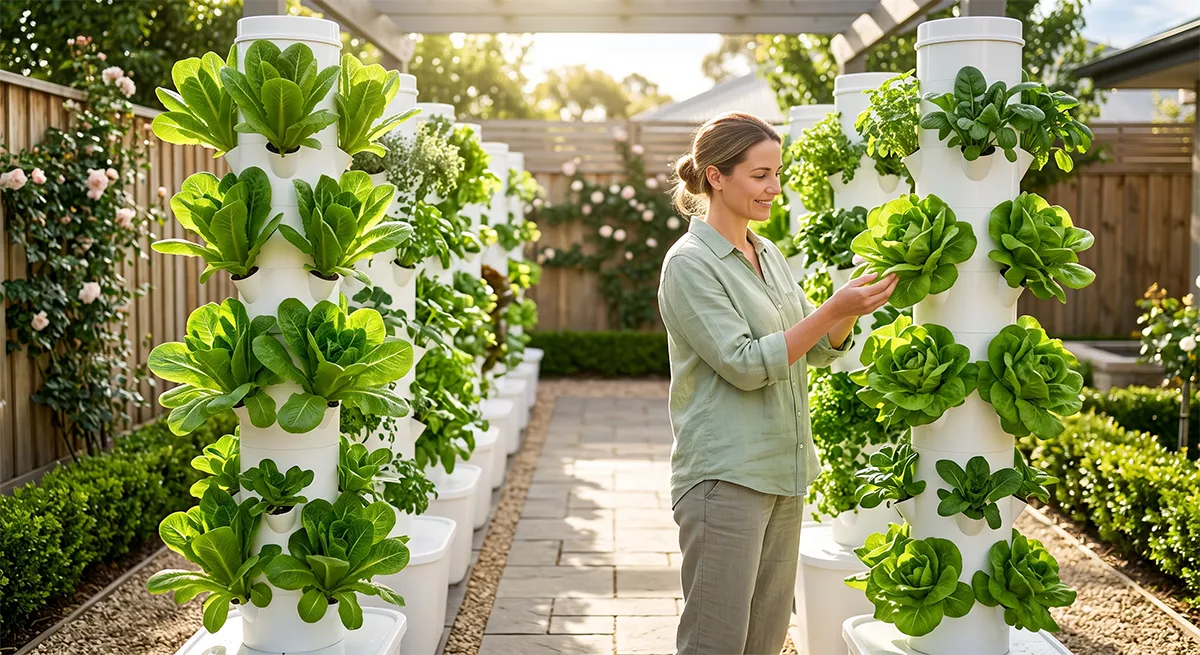
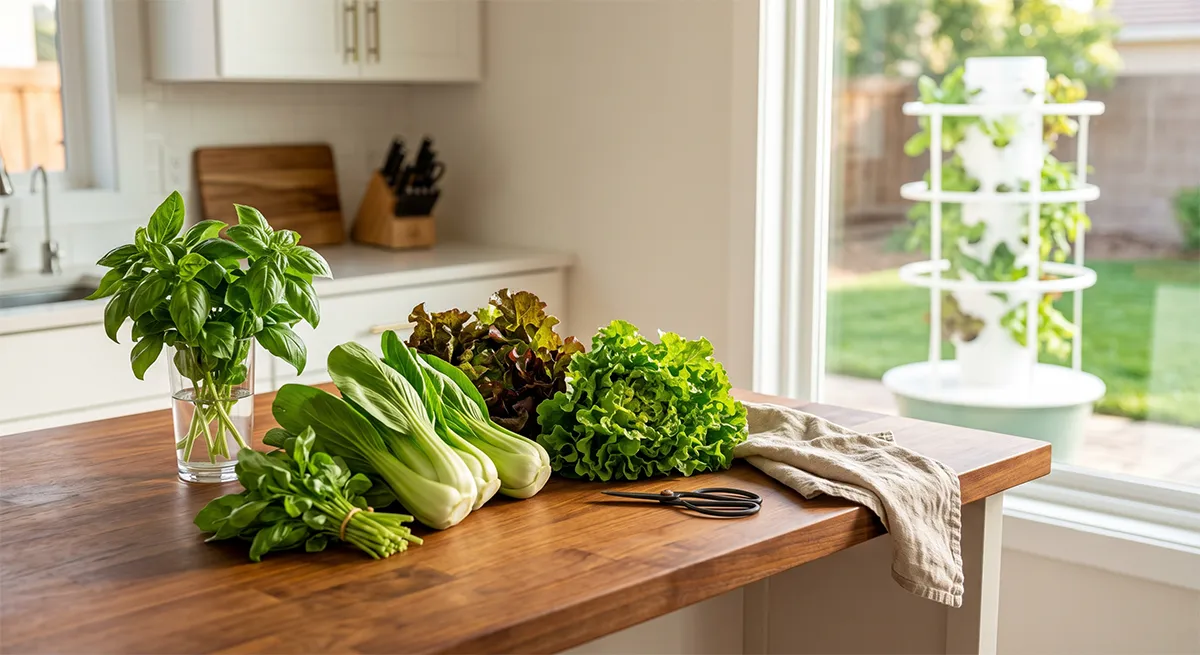
A hydroponic tower garden can transform an ordinary backyard into a compact, highly productive family farm. This premium system utilizes ten Yunzy V12 hydroponic towers, each thoughtfully designed with 60 individual planting sites. Together, these ten towers provide a massive capacity of up to 600 planting positions, making it the perfect environment for cultivating lettuce, bok choy, kale, basil, mint, and a wide variety of other suitable leafy greens and herbs.
For families aiming to grow significantly more produce than a single standalone tower can provide, this multi-tower setup offers a practical and scalable step between a casual home hobby garden and a large-scale commercial hydroponic farm. Traditionally, managing ten separate tower reservoirs demands frequent water level checks, manual refilling routines, and tedious repeated nutrient mixing.
However, incorporating a centralized irrigation and dosing system simplifies this workload dramatically, all while allowing each individual tower to continue operating independently for maximum reliability and disease control.
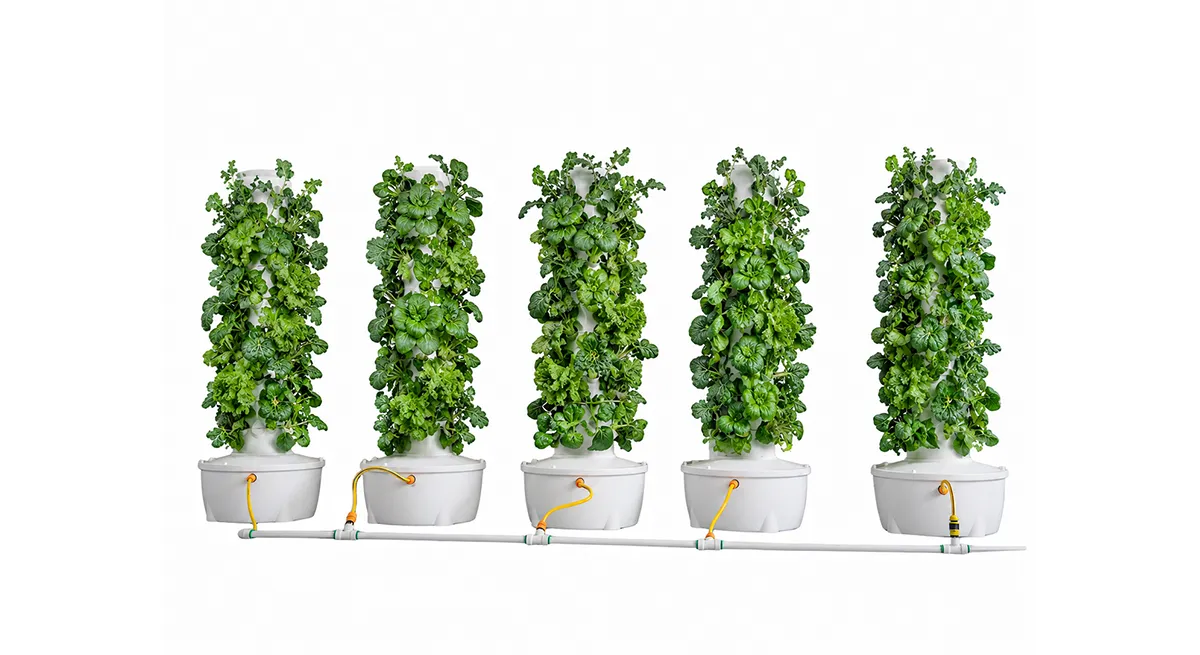
A Small Backyard Farm for Up to 600 Vegetables
Maximizing vertical space is the core advantage of this design. Each Yunzy V12 hydroponic tower provides 60 planting sites. With 10 towers in operation, the math is simple but impressive:
10 towers × 60 planting sites = up to 600 plants.
Under suitable growing conditions, the system can support the robust harvest of up to 600 vegetables or herbs during a single growing cycle. It is important to note that actual harvest results will depend on various environmental and managerial factors, including crop variety, mature plant size, plant spacing, seedling quality, ambient temperature, light conditions, nutrient concentration, water quality, and routine crop management.
Compact leafy greens can typically utilize every available planting position. However, larger plants may require additional spacing for adequate airflow and light penetration, meaning some planting sites may need to intuitively remain empty to support optimal growth.
| System Detail | 10-Tower Backyard Farm Specifications |
| Tower model | Yunzy V12 |
| Number of towers | 10 |
| Planting sites per tower | 16 |
| Total planting capacity | Up to 600 plants |
| Water supply | Centralized |
| Nutrient management | Separate A/B dosing |
| Tower circulation | Independent in each tower |
| Water-level control | Individual float valve |
| Recommended use | Family backyard or small farm |
Who Is This System Designed For?
Because the crops grow vertically, the system can provide a massive amount of planting positions without requiring the large ground area normally needed for traditional soil beds. This backyard system is perfectly suited for growers who require more production capacity than one or two towers can offer, but who do not wish to invest in building a large-scale commercial farm.
It is highly beneficial for:
- Families that regularly consume high volumes of fresh vegetables.
- Large households or shared multi-family community gardens.
- Backyard growers supplying fresh produce to friends or neighbors.
- Small local vegetable sales at farmer\’s markets.
- Restaurants growing their own hyper-local herbs and leafy greens.
- Schools and interactive educational gardens.
- Community growing and sustainability projects.
- Growers testing the waters for a small vertical-farming business.
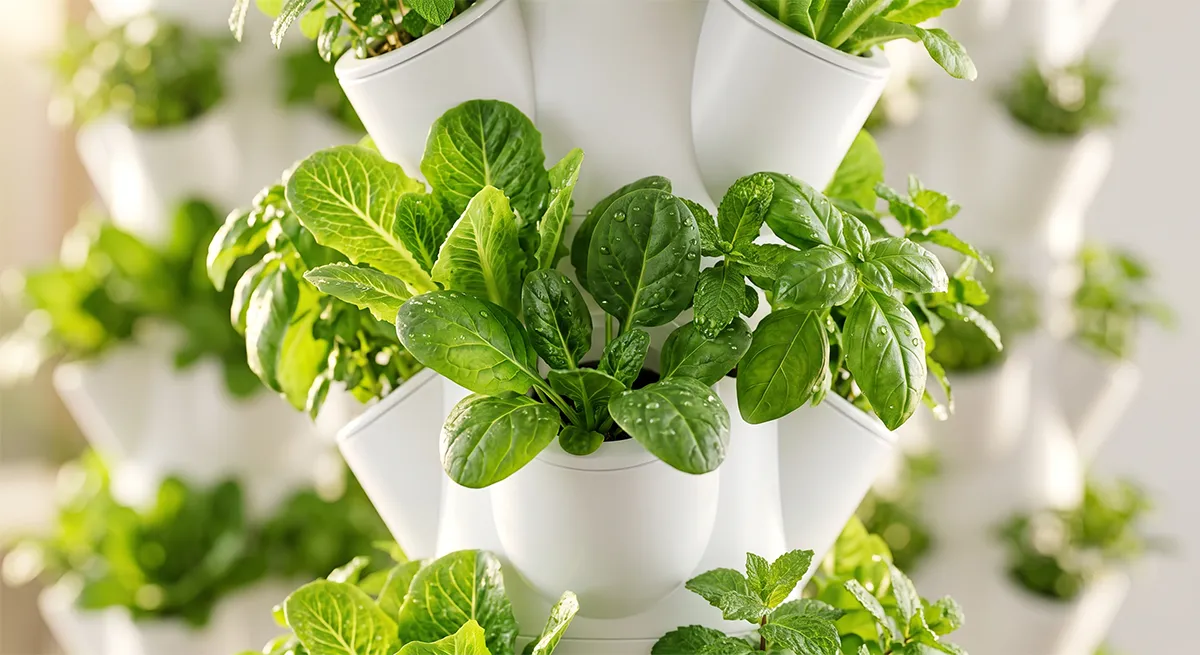
How the Centralized System Is Designed?
A brilliant feature of this setup is its hybrid approach: Centralized supply with independent tower circulation. The ten towers share a central water and nutrient supply, but crucially, they do not share one complete circulation loop.
Each V12 tower independently retains:
- Its own dedicated water reservoir.
- Its own circulation pump.
- Its own individual float valve.
- Its own internal, closed-loop water circulation.
The central system acts purely as a top-up mechanism. It only supplies replacement water and newly diluted nutrients when the water level in a specific tower reservoir falls. Water inside each tower circulates independently to nourish the roots and does not return to the central supply tank, preventing cross-contamination.
Main Components of the System
| System Component | Main Function |
| Clean-water source / main reservoir | Supplies fresh water to the complete system. |
| Booster pump | Provides necessary pressure for the supply and dosing lines. |
| Filter | Prevents particles and debris from blocking dosing equipment and valves. |
| Pressure gauge | Displays real-time supply-line pressure for easy monitoring. |
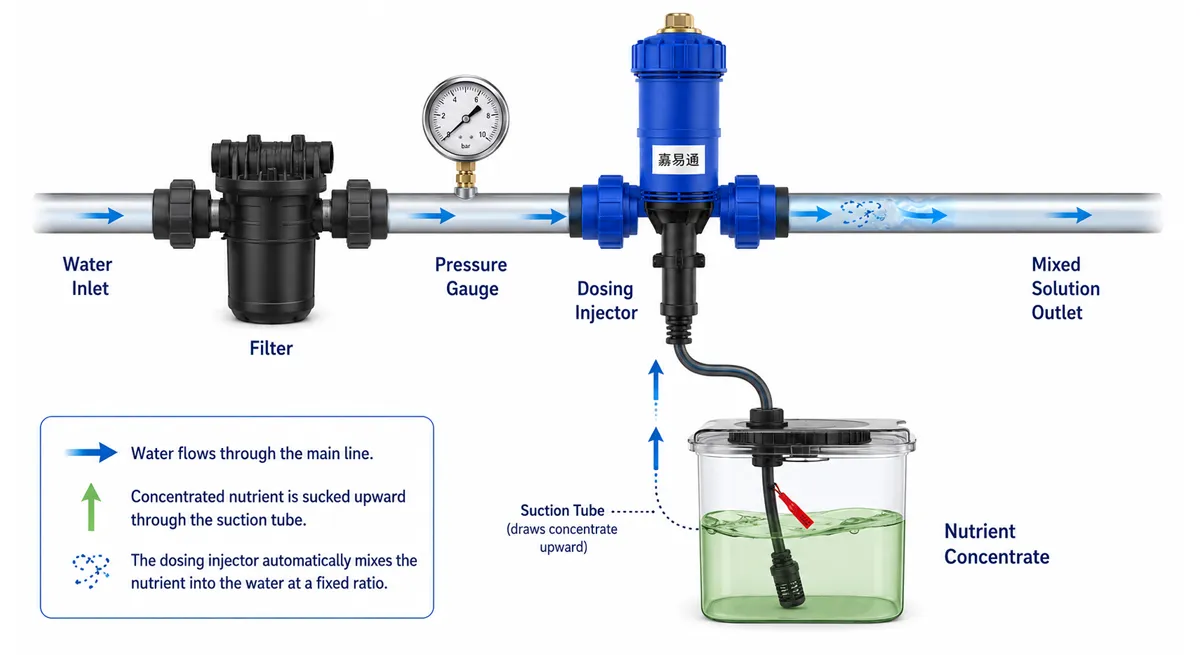
| Dosing unit A | Draws and precisely dilutes nutrient concentrate A. |
| Dosing unit B | Draws and precisely dilutes nutrient concentrate B. |
| Main supply pipe | Carries the perfectly diluted nutrient solution to the farm area. |
| Branch pipes | Connect the main line directly to individual tower reservoirs. |
| Float valves | Automatically control and maintain the water level in each reservoir. |
| Individual reservoirs | Store the nutrient solution specifically for each tower\'s crops. |
| Individual tower pumps | Circulate water vertically inside each tower to feed the roots. |
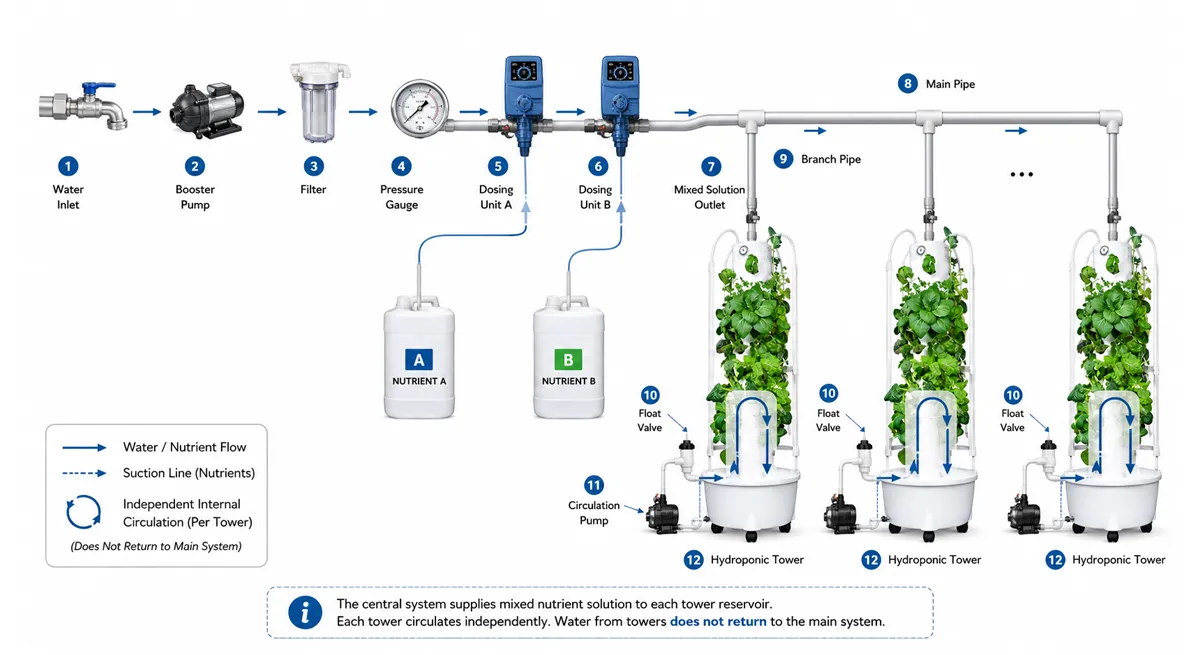
How the Irrigation & Dosing System Works
The Irrigation Flow
1.Clean water enters the primary supply system.
2.The booster pump engages to create sufficient line pressure.
3.The filter safely removes any particles from the water to protect the mechanisms.
4.The pressure gauge displays the current operating pressure for visual confirmation.
5.Dosing unit A draws nutrient concentrate A from its container, while Dosing unit B draws nutrient concentrate B from a separate container.
6.Both concentrates are diluted sequentially in the flowing water.
7.The perfectly mixed nutrient solution enters the main supply pipe.
8.Ten branch lines carry the solution directly to the individual tower reservoirs.
9.When the water level in a specific reservoir falls (due to plant uptake or evaporation), its mechanical float valve opens.
10.The float valve smoothly closes when the preset water level is reached.
11.The tower’s own internal pump continues circulating water up through the tower.
Because of this intelligent design, the centralized line does not need to refill all ten towers at the exact same time. Each float valve responds independently to the specific water level in its own reservoir, ensuring optimal hydration without overflow.
Connecting the Dosing System
The nutrient-dosing system uses two proportional dosing units installed in series on the main water-supply line. The first unit draws nutrient concentrate A, and the second draws nutrient concentrate B. The two concentrates remain entirely separate until they are safely diluted in the flowing water.
For maximum efficiency, each dosing unit should feature:
- A separate nutrient container to prevent premature mixing.
- An individual suction tube.
- A suitable intake filter to avoid blockages.
- An adjustable dosing ratio for fine-tuning nutrient strength.
- Appropriate non-return protection.
- Secure, leak-proof pipe connections.
The outlet from the second dosing unit carries the final, diluted nutrient solution directly into the main irrigation pipe for distribution.
Why Use Separate Dosing Units for A and B Nutrients?
Hydroponic A and B nutrients contain different, highly concentrated mineral components. Mixing the two concentrated solutions directly in the same container will cause the minerals to react and form solid deposits (precipitate) before they can be diluted. This chemical reaction reduces nutrient availability to the plants and will quickly block dosing tubes or delicate irrigation components.
To prevent this, growers must:
- Keep nutrient A and nutrient B in strictly separate containers.
- Use one dedicated suction tube for each nutrient.
- Use a separate dosing unit for each concentrate.
- Inject both concentrates into the flowing water stream.
- Never combine concentrated A and B solutions in advance.
Note on checking levels: The percentage shown on the automatic dosing equipment should be treated as a starting baseline. The final solution should always be verified with an EC (Electrical Conductivity) meter, and the pH should be measured and adjusted before the system is used for actively growing crops.
Why Keep Each Tower Independent?
While they share a water source, maintaining independent reservoirs offers massive operational advantages:
One Problem Does Not Stop the Entire Farm: If one tower pump requires cleaning or replacement, the other nine towers continue operating completely unaffected, protecting your overall yield.
Easier Maintenance: Each reservoir can be individually inspected, cleaned, or flushed without the need to drain the entire 10-tower system.
No Large Common Return Line: The system only requires a central supply pipe. It avoids the clutter and expense of a complex return pipe carrying water from all ten towers back to a massive main tank.
Easier Future Expansion: Additional towers can be seamlessly connected later, provided the main reservoir, booster pump, pipe diameter, dosing capacity, and total flow rate are sufficient.
More Flexible Crop Management: Different towers can be customized for different crops or distinct planting stages. For example:
- Two towers dedicated to lettuce.
- Two towers for bok choy.
- Two towers for kale.
- Two towers for basil and herbs.
- Two towers reserved for seedlings or newly transplanted crops.
Planning and Installation
Suggested Backyard Layout
A highly practical and space-efficient layout consists of two rows of five towers, separated by a central working aisle.
| Row A | Central Aisle | Row B |
| Tower 1 · Tower 2 · Tower 3 · Tower 4 · Tower 5 | Harvesting, inspection, and maintenance access space | Tower 6 · Tower 7 · Tower 8 · Tower 9 · Tower 10 |
| Run the main supply pipe along the row | Keep pathways clear of debris | Main reservoir and dosing equipment placed at one end |
The central aisle is critical, providing necessary space for plant inspection, harvesting, cleaning, pump maintenance, reservoir access, and moving tools.
Installing the main reservoir and dosing equipment at one end of the growing area makes it much easier to refill nutrient containers, check pressure gauges, clean the filter, and operate the main water shut-off valve. When spacing towers, always account for the mature size of the crops, not just the width of the bare towers.
Planning the Growing Area
- Sunlight: A system without integrated grow lights requires sufficient natural sunlight. Requirements vary by crop, location, and season. If the yard is heavily shaded, supplemental lighting or repositioning is necessary.
- Water Supply & Drainage: The main reservoir should be convenient to refill. Although the system recirculates water, nearby drainage is highly useful during cleaning, maintenance, or in the event of an accidental overflow.
- Electricity: The booster pump and individual tower pumps require safe, reliable electrical access. All outdoor electrical connections must be properly rated and protected from water and weather exposure.
- Ground Condition: Towers must be installed on a stable, perfectly level surface. Uneven ground will negatively affect reservoir water levels and disrupt float-valve operation.
Operating the 10-Tower Farm
While automation significantly reduces repetitive manual labor, a successful hydroponic system still requires consistent, routine inspection to ensure optimal plant health and system longevity.
| Frequency | Routine Maintenance Task |
| Daily | Check plant health, ensure consistent water flow, inspect for leaks, and verify reservoir levels. |
| Every few days | Measure and adjust EC (nutrient concentration) and pH levels. |
| Weekly | Inspect nutrient containers, clean system filters, and ensure float valves move freely. |
| Weekly | Listen to and check pumps, inspect pipe fittings, and verify dosing suction tubes. |
| As needed | Carefully remove rogue plant roots or debris near water outlets to prevent blockages. |
| Between crops | Thoroughly clean and sanitize reservoirs, pumps, and individual tower sections before replanting. |
Managing 600 Planting Positions (Staggered Planting)
With 600 positions available, it is rarely best to plant everything on the same day. If all ten towers are planted simultaneously, a massive amount of crops will become ready for harvest at the exact same time, producing far more vegetables than a single family can consume before they spoil. Implementing a staggered planting schedule guarantees a continuous, manageable harvest.
| Tower Group | Number of Towers | Planting Time |
| Group A | 2 | Week 1 |
| Group B | 2 | Week 2 |
| Group C | 2 | Week 3 |
| Group D | 2 | Week 4 |
| Group E | 2 | Week 5 |
Frequently Asked Questions (FAQ)
Do all ten towers share one reservoir?
No. The central system acts as a supply line for water and diluted nutrients, but every single V12 tower maintains its own dedicated reservoir at its base.
Does water return to the main reservoir?
No. Water circulates independently inside each tower. There is no common return line carrying water back to the main reservoir, which helps prevent the spread of root diseases across the whole crop.
Can the dosing units be installed in parallel instead of series?
Parallel dosing installations are generally reserved for setups where a much higher total flow rate is required. For a small-to-medium A/B nutrient system like this, installing two units in series is usually simpler and highly effective, provided the selected equipment supports the required flow.
Does the automated dosing system eliminate the need for EC and pH testing?
No. While automatic dosing drastically reduces manual mixing labor, the final nutrient solution should still be manually checked on a regular basis with calibrated EC and pH testing equipment to ensure a perfect growing environment.
Is the system suitable only for family use?
Not at all. While perfect for large families, it is incredibly effective for farm-to-table restaurants, schools, community gardens, small greenhouses, and entrepreneurs testing a small local vegetable business.
Final Thoughts
A 10-tower hydroponic tower garden can swiftly turn a suitable backyard into a lush, productive small family farm. Ten Yunzy V12 towers provide an astonishing 600 planting positions, utilizing vertical space with maximum efficiency. By integrating a centralized irrigation and A/B nutrient-dosing system, growers can eliminate repetitive water refilling and tedious nutrient mixing.
Because each tower retains its own reservoir and circulation pump, this independent design makes the system vastly easier to inspect, maintain, and expand compared to older systems where all towers depend on a single, vulnerable circulation loop. With strategic layout planning, accurate dosing calibration, staggered planting schedules, and routine maintenance, this system will provide a continuous, abundant supply of fresh, healthy vegetables.
Planning a 10-tower backyard farm? Contact Yunzy for comprehensive system configuration, tailored layout suggestions, complete accessories, installation diagrams, 3D installation guidance, premium one-on-one support, and our dedicated two-year after-sales service.

0 Comments